
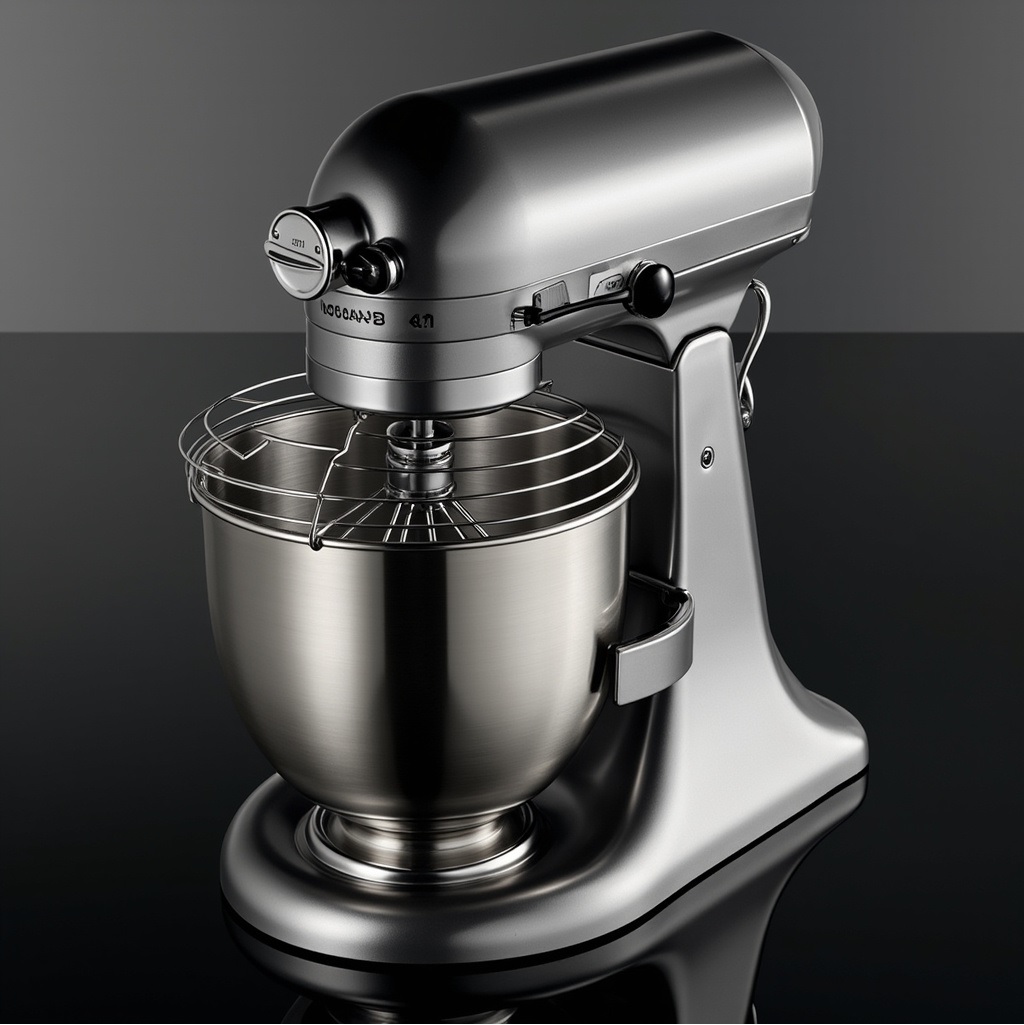
If you have ever watched a planetary mixer struggle to fold stiff dough into the corners of a flat-bottomed bowl, you already understand the problem. The center mixes perfectly while the edges stay stubbornly dry. That is not a user error. That is a geometry failure. The tilted pan design solves this by breaking the rules of gravity itself, forcing ingredients back into the blade path rather than letting them hide along the walls. This is not a subtle tweak. It is a fundamental rethinking of how a mixing chamber should behave.
Think about what happens in a standard straight-walled bowl. The beater rotates, flings material outward, and the mixture climbs the sides. You stop the machine, scrape down the bowl, start again. Repeat. That lost time adds up fast, especially when you are running multiple batches of heavy batter or dense meat mixtures. The tilted pan eliminates that scraping cycle because the bowl is angled. Gravity does not let the product sit still. It slides downward, back into the rotating blades, creating a continuous folding action that a flat bowl simply cannot replicate.
Here is the real kicker: efficiency is not just about speed. It is about consistency. When a mixer has to stop every few minutes for manual scraping, the temperature of the mixture fluctuates. The aeration changes. You introduce human error every time someone opens the lid and sticks a spatula in there. A tilted pan keeps the process closed, uninterrupted, and thermally stable. For bakeries running high-volume production, that means every loaf or pastry starts from the exact same baseline. No variation between batches. No guesswork.
Now, let us talk about the actual physics. The tilt does not have to be dramatic. Usually, it is around fifteen to twenty degrees off horizontal. That small angle is enough to shift the center of gravity of the mixture toward the blade zone. The result is a shorter mixing time, sometimes by as much as thirty percent, depending on the viscosity of the product. For thick doughs like bagel or pretzel mixes, that time saving is enormous. You are not just saving electricity. You are saving wear on the motor and gearbox because the machine is not fighting against dead zones.
When you are shopping for a intensive mixer, look at the locking mechanism. A pan that tilts but does not lock securely is a hazard waiting to happen. The best designs use a heavy-duty cam lock that engages with a single lever motion. Also check the seal between the pan and the mixing head. If that seal is weak, you will get leakage at high speeds, and that is a mess you do not want to clean. REFAMIX has engineered their tilted pan line with a double-seal system that holds up under continuous commercial use. That is the kind of detail that separates a workhorse from a toy.
Another factor people overlook is the blade clearance. In a tilted pan, the blade path is not perfectly centered. It is offset to match the angle. If the manufacturer did not adjust the geometry accordingly, you will still get unmixed pockets. The good news is that reputable brands like REFAMIX have spent years refining that offset so that the beater sweeps within millimeters of the pan surface at every point. That is precision machining, not just a bent bracket.
Do not assume that a tilted pan is only for heavy dough. It works just as well for light emulsions, whipped creams, and even delicate meringues. The key is speed control. A variable speed drive lets you start slow to incorporate ingredients, then ramp up without splashing. The tilt keeps the mixture from crawling up the sides and escaping the beaters, which is a common problem in straight bowls when you push the RPMs too high.
If you are running a commercial kitchen, the math is simple. A tilted pan mixer can cut your batch cycle by fifteen to twenty minutes per run. Over a ten-hour shift, that is an extra batch or two of product. Over a year, that is thousands of dollars in additional output without hiring more staff or buying another machine. The upfront cost is slightly higher than a standard mixer, but the return on investment is brutal in the best way.
One last thing: cleaning. A tilted pan drains faster. You tilt it forward, rinse, and the water runs straight out. No reaching into a deep bowl with a hose. No standing water collecting at the bottom. That might sound like a minor convenience, but in a busy kitchen, every minute saved on sanitation is a minute earned for production. REFAMIX has even added a quick-release bowl feature on some models that lets you detach the entire pan in seconds for deep cleaning.
Do not buy a mixer based on horsepower alone. Look at how the bowl interacts with the blade. Look at the angle. Look at the seals. The tilted pan design is not a gimmick. It is a mechanical advantage that turns wasted motion into usable torque. Your dough will thank you. Your schedule will thank you. And your bottom line will definitely notice the difference.
