
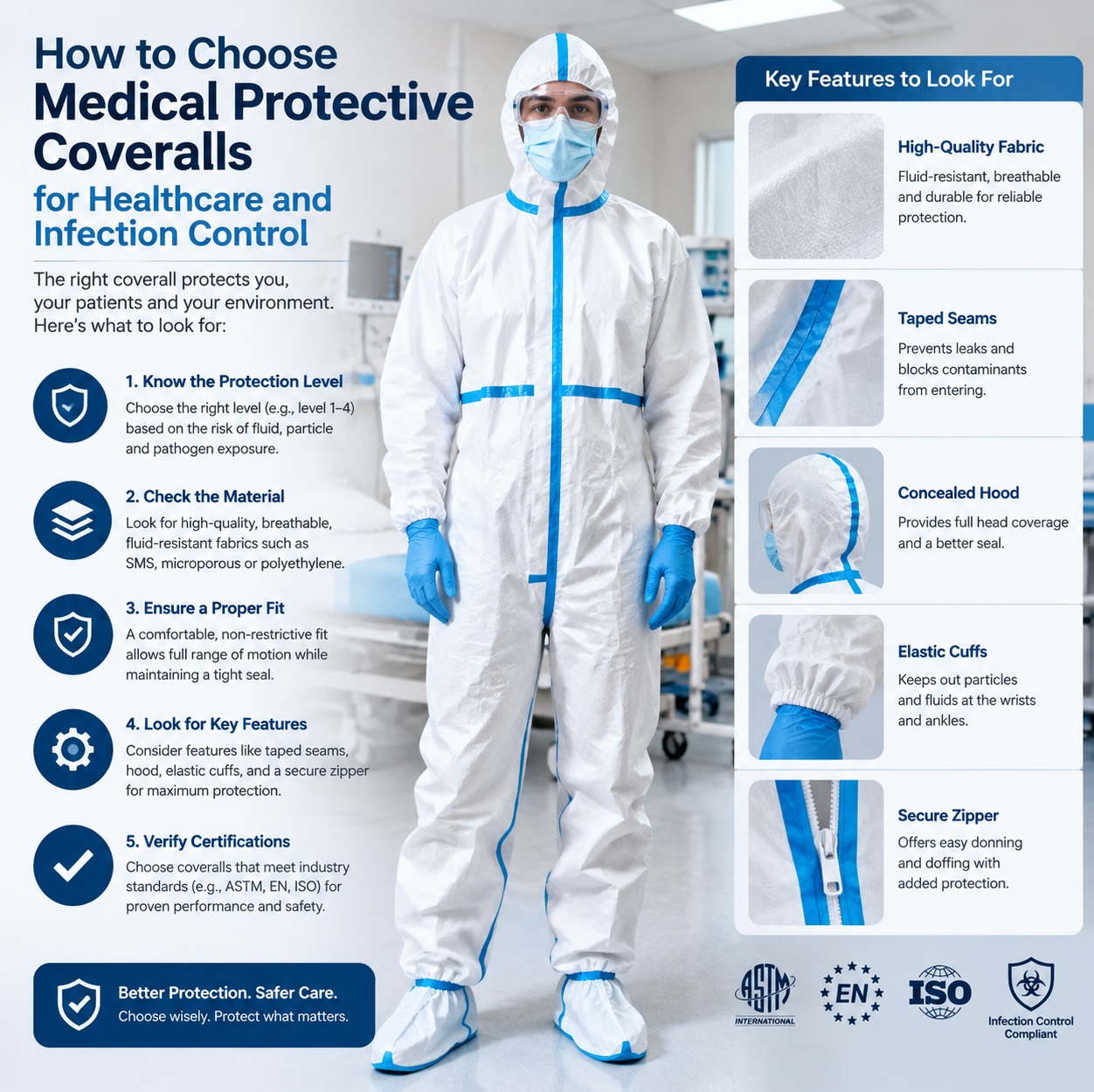
A coverall that passes a splash test in a lab can still fail a nurse on an isolation ward if the zipper flap curls, the hood gaps, or the fabric turns into a sauna. That is the uncomfortable truth about medical protective coveralls: the spec sheet gets you into the conversation, but the details decide whether infection control holds up during a real shift.
If you are buying for a hospital, clinic, long-term care facility, or distribution program, here is what separates a smart purchase from a costly box of false confidence.
Start with the hazard, not the price tag.
The first question is not “What is cheapest?” It is “What am I protecting against?” Bloodborne pathogens, body fluids, respiratory droplets, airborne particles, contaminated dust, and chemical splashes all demand different levels of barrier. A coverall for general isolation may need a different construction than one for high-fluid surgery or decontamination. Match the coverall to the task. If the risk includes pressurized splashes or infectious agents, you want documented barrier performance, not a vague “medical grade” label.
Read the certifications like a clinician reads vitals.
A credible medical protective coverall should come with test data, not just a brochure. Look for EN 14126 for protection against infectious agents, and check which performance levels apply. Type 3, 4, 5, and 6 ratings tell you whether the garment resists liquid jets, liquid sprays, airborne solid particles, or limited liquid splashes. For blood and body fluid resistance, ASTM F1670 and F1671 matter. For viral penetration, ISO 16603 and ISO 16604 are worth asking about. In the United States, AAMI PB70 levels are common for surgical and isolation gowns, but coveralls often sit in a different regulatory lane. The point is simple: if the supplier cannot show you the test reports, keep looking.
Fabric is a trade-off, not a magic bullet.
SMS and SMMS fabrics offer breathability and decent barrier for many healthcare tasks. Microporous film laminates push barrier higher, but they can trap heat. Breathable films try to balance the two, and they often cost more. There is no perfect fabric for every setting. An emergency room during a heat wave has different comfort demands than a decontamination team handling chemical splash. Ask about hydrostatic head, moisture vapor transmission rate, and abrasion resistance. Then ask whether those numbers actually fit the way your staff will wear the coverall.
Seams, zippers, and flaps are where leaks happen.
A great fabric can be undone by a weak seam. Serged seams are common and economical. Bound seams are stronger and cleaner. Taped seams give the highest barrier for high-risk fluid exposure, because they seal the stitch holes. Check the zipper flap. Does it lie flat? Is it wide enough? Does it have an adhesive strip or storm flap? Look at the hood, cuffs, and ankles. Elastic should be snug without cutting off circulation. Thumb loops can keep sleeves in place during doffing, but only if they are comfortable. Small design choices decide whether a coverall protects or just looks protective.
Fit is infection control.
A coverall that is too loose can snag on equipment and expose skin during doffing. One that is too tight can rip at the shoulders or restrict movement. Healthcare workers come in every shape and size, so a real size range matters. Ask for a size chart that includes height and chest measurements, not just S, M, L, XL. If possible, run a donning and doffing trial with actual staff. The best coverall in the world is useless if someone cannot remove it without touching the contaminated outer surface.
Comfort keeps compliance alive.
If staff hate wearing a coverall, they will pull it down, reuse it, or skip it when they think no one is watching. Breathability, softness, and low noise matter more than many buyers admit. Heat stress is a real safety issue. Look for coveralls that manage moisture vapor while maintaining the barrier level you need. A slightly higher unit price can be cheaper than lost productivity, heat exhaustion, or a breach in protocol.
Check the boring supply chain stuff.
Consistency is a quiet superpower in PPE. Can the supplier deliver the same fit, fabric, and seam quality across batches? Is there lot traceability? Are the coveralls sterile or non-sterile, and does that match your use case? What is the shelf life? How are they packaged? Can you get documentation for audits? If you are buying at volume, ask about lead times, minimum order quantities, and whether sizes can be mixed in a carton. A great sample means nothing if the next shipment fits differently.
Ask for evidence, then test before you commit.
Request third-party test reports, batch records, and samples. Wear the sample. Doff the sample. Stretch, squat, and reach. Compare it against your current coverall. If the supplier gets defensive about data, that is your answer. If they send a sample that matches the spec exactly, that is a good sign. If they offer training materials for donning and doffing, even better.
The right medical protective coverall is not the one with the loudest marketing claim. It is the one that matches the hazard, fits the team, survives doffing, and comes with paperwork you can defend. If you are sourcing for healthcare and infection control, demand samples, demand data, and demand consistency. Your staff will not remember the price per unit. They will remember whether they felt protected
